Showing posts with label PBL. Show all posts

Monday, January 14, 2019

Building Relationships and Empathy with EdTech

This post was originally posted on the Teaching4Tomorrow Blog. 

One of the most powerful moments in my 22 years of teaching occurred on the last day of the school year. 


During the first week of school, my students in rural Pennsylvania played a game via Skype with a group of students in a rural Kenyan village. During that call, they learned of a bridge in the village so dangerous that many children were not able to go to school because of it. Over the course of the school year, the children in Kenya taught my students how to garden. In exchange, my students designed and fundraised to replace that bridge. 

On the last day of school, I was able to share with my 5th grade students the picture I received of the completed bridge. Every one of the children in his village could now safely receive an education, and every one of my students learned how powerful they could be when they use learning to make the world a better place. Their unlikely friendship with children 7,500 miles away helped change not only how they felt about others who looked different than them, but also how they felt about themselves. Through global connection in our classrooms, we can teach our children how to be compassionate and empathetic. 

The key lies in helping students find a shared humanity with classmates and with others around the globe. We set the foundation for a peaceful future when we help students see each other as humans first, rather than through the lenses of limited identities that include race, ethnicity, religion, nationality, and politics. 

Most teachers want to foster empathy and a sense of shared humanity in their classrooms, but don’t know where to start. Luckily, we live in a time when free technologies exist that help us do this. Best of all, they are easy to use in the classroom.

Empatico is a free tool for connecting elementary classrooms around the world.* It takes less than five minutes to register and get started. After choosing one of nine activities that connect to most school curricula, you enter the dates and times that your class is available to connect. The website automatically connects your class with another more than 300 miles away that is available at the same time and looking to do the same activity. My students are currently building relationships with friends 1,000 miles away in Georgia as they work on a joint science project.

When children walk into my classroom and see the webcam and projector set up for a virtual call, they have trouble containing their excitement.

For middle school and high school teachers, as well as elementary teachers looking for multiple connections, the combination of the Skype in the Classroom website and the Skype videoconferencing software can create amazing opportunities for students. On the website, you can find thousands of teachers from around the world willing to connect with your students. 

My classes love playing games like Mystery Skype, which is related to the game 20 questions, with new friends that they are meeting via Skype for the first time. When playing these games, you don’t have to worry about language barriers. If you are using the latest version of Skype on a PC computer, the program has a built-in translator that will allow your students to communicate, even if they speak different languages. 

I have seen many times how these classroom connections can lead to cross-cultural relationships and students finding a shared humanity. In the past few years, my students have broken through the isolation of our rural area to travel to 95 different countries, the International Space Station, and to Antarctica. 

I often get asked how this type of learning fits into the curriculum. We need to shift from the curriculum being the basis of our planning. Start by designing incredible experiences. Create the kind of learning environment that makes kids want to beat down the door of your classroom to be a part of it. 

Then find ways to attach the curriculum you teach to the experience. If we model the same creativity and critical thinking that we are demanding of our students, this should not be hard. 

Once we connect the curriculum to unforgettable experiences, students will retain the lessons we are trying to teach them forever. Start small by giving students opportunities to connect and learn with tools like Empatico. Then move into lessons like Mystery Skype that take a little more planning. When you get comfortable with those lessons, start looking for virtual field trips and other global experiences where your students can learn from scientists, authors, museums, and national parks. 

Before you know it, your students will be world travelers and they won’t have left your classroom. More importantly, they’ll be learning with others who live in different locations, have different backgrounds, and a different view of the world. They’ll be developing the skills to be empathetic and compassionate lifelong learners, and they’ll be gaining practice with the tools they’ll need to make the world a better place.

Michael Soskil is a speaker, teacher, author, and host of the Education for a Better World Podcast. He is the 2017–18 Pennsylvania Teacher of the Year and was named one of the top 10 teachers in the world by the Global Teacher Prize in 2016. The book he co-authored, Teaching in the Fourth Industrial Revolution, has been called “an authoritative guide to teaching practice over the next three decades” and has been endorsed by world leaders in government, education, and business. To learn more about Michael’s work or to inquire about him speaking at your next teacher workshop or event, please visit his website at MichaelSoskil.com.

*Disclosure: I have received compensation for consulting work with Empatico, which is an initiative of the nonprofit KIND Foundation, but the views in this post are my own based on experience. 

Saturday, November 3, 2018

Stop Pretending and Make School Relevant

Anyone who has been in a teacher training session in the last two decades has heard that we need to make school relevant. Usually these words of wisdom are accompanied by a statement about the need to tell kids how our content connects to the 'real world' so that children know why they are being coerced to learn the content we are putting in front of them.

Nonsense.

Telling a 4th grader that in a decade they will need to use multiplication someday when they are buying apples in the grocery store, trying to convince a middle school student that finding the main idea of a non-fiction passage will be vital in their future career, or asking a high-school sophomore to know the function of a mitochondria because someday they might be a doctor are all great ways to get children to drool on their desks out of boredom rather than actually engaging in learning.

If you have spent time around any children of school age, you know that this will not convince them that the content they are learning is relevant. The frontal lobe of our brain, which allows us to understand the consequences of our actions, is not fully developed until our mid-twenties.

In schools, we need something more effective than, "Trust me. I'm an adult."

If we want school to be relevant to what's going on outside our school walls, we actually need students to get involved in using learning to solve problems outside our school walls.

If we want school to be relevant, make it relevant. Don't pretend it's relevant and try and sell that to kids.

Students working on building aquaponics units out of recycled
materials to help those in regions with drought.
The content we teach has real applications to make the world a better place. It's our job as teachers to help children see the connections.

Problem-based learning, when combined with a focus on improving students' local and global communities, creates a dynamic environment in which students don't have to wonder why they are learning. They know they need to learn in order to make their world a better place.

Using learning to make the world a better place is exactly what education should be about. Many of our school mission statements include language about creating contributing members of society and good citizens.

Early in my career, I remember helping 5th graders understand fractions by planning and cooking a Thanksgiving dinner for a family in need. More recently my 4th and 5th grade students have designed and facilitated a global video learning exchange that helped children with limited resources learn with math manipulatives. They collaborated on a global garden project where students exchanged techniques they learned to grow food. When they met children in a rural Kenyan village that couldn't go to school because the community bridge was dangerous, my students used the learning in their science class to design a new bridge that was built with funds they raised. Last year, after hearing about the drought and famine affecting children in Malawi, my 5th grade students designed aquaponics units out of recycled materials that grew food with 90% less water than traditional farming.
Book written and published by Beth Heidemann's students

My students don't ask me why they are learning. The relevance is obvious.

If you teach younger students, know that children are never too young to change the world.

When Beth Heidemann's kindergarten students in Maine learned that the friends they met in the Kibera Slum of Nairobi faced food insecurity issues that mirrored some of the issues in their rural town, they wrote a fairy tale. It was set in Kenya and described children overcoming problems due to lack of food. They published the book and used the proceeds to send funds to both their local food pantry and their friends in Kibera.

It is vital that this relevance extends to all subject areas, including the arts. The arts allow children to learn to perceive beauty in the world. More importantly, though, the arts allow us to emotionally connect with each other. They allow us to develop empathy and find our shared humanity.

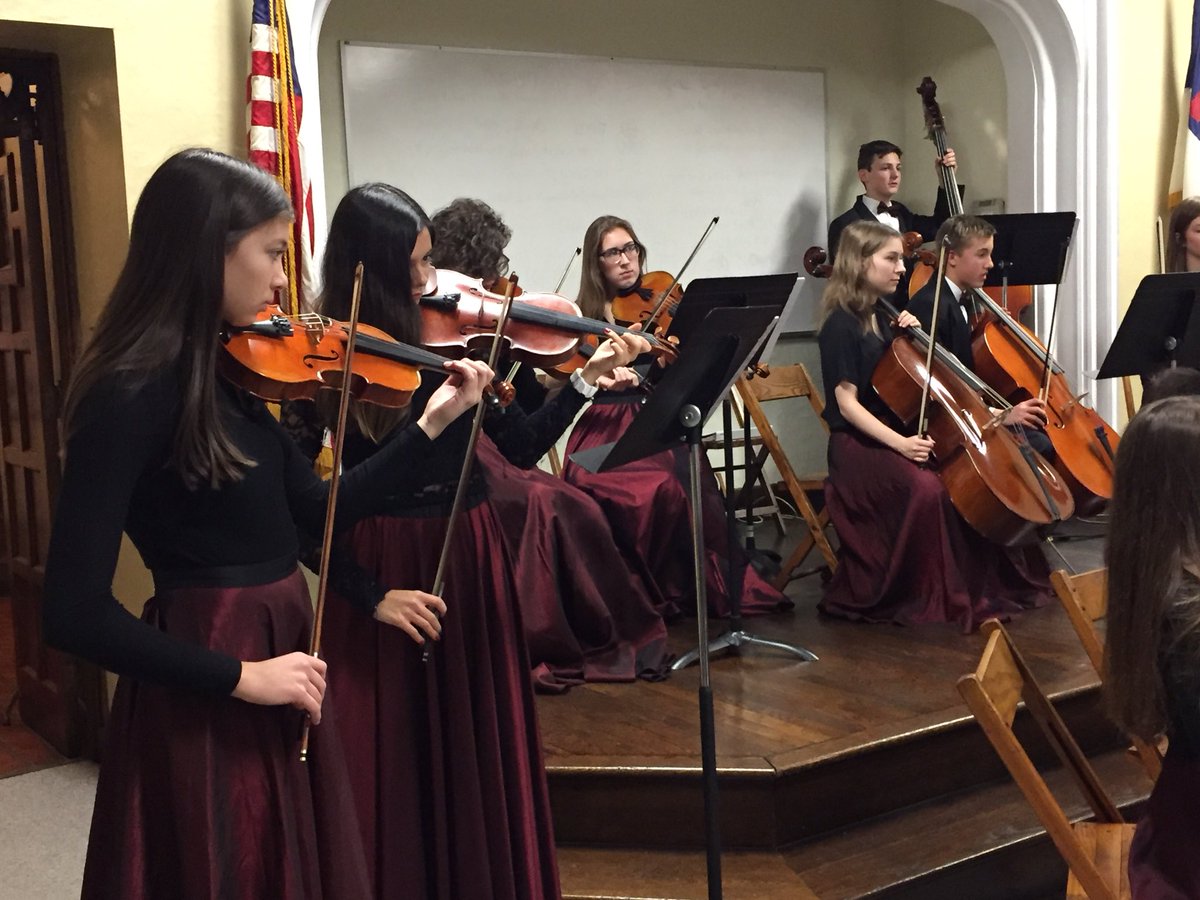
Mairi Cooper's orchestra students have used the design process to innovate new ways to use music as a tool for social good. Using "pop-up concerts," they have found ways to bring the beauty of orchestra music to people in locations that otherwise would not have access, including homeless shelters and children's hospitals.

Students in any subject area or grade level can find true relevance in their learning if we give them the autonomy, resources, and support.

Mairi Cooper's students performing at a center for the blind.
Picture credit: Twitter.com/patoy2015
We must understand that true relevance comes when the purpose of school is detached from the tests, quizzes, grades, and rankings that we have used for decades.

If we hold dear to our traditions and tell children that school is relevant, while at the same time our actions show them that what we really care about are arbitrary numbers written at the top of Friday's test, state assessment scores, or class rankings, our students will see right through us.

While mindset shifts can be scary and take time to fully develop, here are some ways to get started:

  1. Understand that the learning in your classroom belongs to the learners and not to the teacher. Make small changes to move from a coercive environment to a learning environment where inspiration is used to motivate. Give your students as much autonomy and choice over classroom rules, curriculum, and application of learning as you can.
  2. Start with local issues. Help students begin thinking about ways their learning can be used to make their community better. Over time, help them understand that they are also part of a global community. 
  3. Use the United Nations Sustainable Development Goals (SDGs) as the basis for connecting required content to initiatives to make the world a better place. TeachSDGs.org is a great tool for helping students see the context for the content they learn. 
  4. You can't change the world if you don't know much about it. Use free videoconferencing tools to allow your students to learn with other students in distant locations. 
  5. To learn more about how to shift toward a Project/Problem Based Learning environment, start with Ginger Lewman's book "Lessons for LifePractice Learning." 
Michael Soskil is a dynamic speaker, professional learning facilitator, author, & one of the most highly recognized teachers in the world. The book he co-authored, Teaching in the Fourth Industrial Revolution, has been called "an authoritative guide to teaching practice over the next three decades" and has been endorsed by world leaders in government, education, & business. To learn more about Michael's work or to book him as a speaker for your next teacher workshop or event, please visit his website at MichaelSoskil.com.

Wednesday, July 8, 2015

Global Service Learning

While at ISTE last week, I had the pleasure of meeting Bob Greenberg, who interviewed me for his Brainwaves Video Anthology series. Bob seeks out "thinkers, dreamers, and innovators; some of the brightest minds in education" and seeks to record their stories to help inspire other teachers.  It was an honor to be chosen by Bob to be a part of this project.  Below is my 4 minute talk about the power that global service learning has had on our students at the Wallenpaupack South Elementary School.


Friday, October 26, 2012

The Fight Against Common Core Irrelevance

We've been told again and again that the Common Core Standards are being put into place to prepare our students to be ready for college & career when they graduate high school.  These standards are supposed to better prepare students for life.

So why are schools buying textbooks to implement them?  If these standards are supposed to prepare our kids for life, wouldn't it make sense that the best way to teach them would be through life simulations?

Shouldn't every one of these standards have a real-world application?  And if so, why aren't we giving students the opportunity to use them in real-world settings?

The more we make a separation between the "real world" and the "fake world" of school, the more students will realize that we are irrelevant.  And they'll be right.

Tuesday, February 28, 2012

Swimming Upstream

For the past few days I've been really excited about a few ideas that I've been working on for my students in the next month or two.  One involves a lesson where we'd research ancient civilizations and what archaeologists do for a bit and then create artifacts from a made-up civilization.  If I could find another 5th grade class willing to do the same we could exchange artifacts and use the techniques of archaeologists to try and figure out information about the other class's civilization.  Another lesson would focus on studying the mathematics and science of flight by building a life-size set of wings. 


Image: Simon Howden / FreeDigitalPhotos.net

I have no doubt that these lessons would lead to excitement, engagement, authentic learning, higher order thinking, and collaboration within and among my students.  The problems I keep running into are logistical.  Like most schools, our day is segmented into 40 minute periods.  Rarely do I have my students for more than 80 minutes at a time.  The money to fund these projects will have to come from somewhere - probably my pocket unless I can find someone to donate what we need.  We will need to collaborate with experts but the computers available to students have neither webcams, nor Skype installed.  The students in my math class and my reading classes are different.  I'll have to sell the projects to special area teachers and see if I can get them to work with us. 

All of these logistical problems can and will be overcome, and I plan to go ahead with both projects.  I just wish that our schools were set up for real learning.  We all want students to be actively engaged, but our system is set up to make it so easy to have them sitting in rows silently working out of a textbook.  Sometimes doing the really great stuff that everyone agrees is wonderful for students is difficult to organize and pull off in this environment.  Sometimes it feels like we're swimming upstream.

Friday, February 17, 2012

Friday's Five - Our Students Need to Believe They Matter

It's human nature to want to matter.  We all have that desire.  It motivates much of what we do.  For some, it motivates them to seek financial success.  For others, it motivates them to do charity work.  For me, it was a driving factor in why I became a teacher.

Our students have this need as well.  Unfortunately, many of our traditional practices in education make students feel that they have no worth.  It's a primary reason why our students are lacking motivation.  Why work hard if you and what you produce don't matter?

Flickr/just_makayla
I've heard many educational experts tell me that the way to solve this problem is to tell students why what they are doing in school will relate to their life when they get out of school.  Our students don't care about this.  The long technical reason is that their frontal lobes aren't completely formed, and such rational, unemotional thought is not possible for them.  The short reason is that asking a kid to trust you and be motivated by something that may or may not benefit them 5, 10, 15, or 20 years down the road is absurd.  Our kids need to feel important now.  If we want them to learn, we'd better start meeting this need.  Here are five ways to allow kids to feel that they matter.
  1. Problem Based Learning (PBL)  If you want kids to feel that that matter, have them do something that matters.  There are a multitude of problems that need to be solved in our communities. Challenge your students to solve them.  How can we help the local food pantry raise money?  How can we effectively publicize the upcoming blood drive in our school?  What data can we collect and use to prove that there needs to be a stoplight at the intersection near the school? 
  2. Publish their work. It is insulting to a student to work hard on a project, paper, or other in-depth assignment with the end result being that a teacher looks at it, judges it, and hands it back with a number or letter on top of it.  Use a class blog, wikispace, or other avenue to publish their work.  Let them share with friends and family around the globe.  Let their research be used by others.  Give them an audience other than the teacher.  Better yet, let them publish their writing in a book using a site like lulu.com and use the proceeds to solve a community problem like the ones described above.
  3. Stop expecting students to be motivated by grades.  Grades are a way to rank, sort, judge, and punish students.  They are not an effective way to motivate students.  A plethora of studies show that external motivation is not lasting and will not serve our students in life.  We need to give them the experiences of learning for the pleasure of learning, feeling the joy of helping others, and being valued for reasons other than being the best hoop jumper in the class. An emphasis on grades undermines our ability as teachers to give our students those experiences and does nothing to lead our students to believe they matter. 
  4. Allow students opportunities to consult, collaborate with, and learn from community members.  If you want students to believe that their math lesson is important to their life, bring in a member of the community who uses that math in their job every day to share his/her experiences with your students.  Then allow the students the opportunity to be an accountant, small business owner, mechanic, home builder, etc.  The same opportunities can be worked into classes in almost every subject area.  In addition to the valuable career awareness that comes from these types of interactions, there is the chance for students to do work that is necessary in the community.
  5. Allow students to use tools current to the generation in which they are living.  Forcing students to read outdated textbooks to get information, having them spend hours answering questions that have easily "googled" answers, and not allowing them to use 21st century tools to demonstrate their learning not only makes school seem woefully irrelevant, but sends the message to our students that we don't respect them.  If we did respect them we'd allow them to share their learning using tools and in ways that are familiar to them, regardless of our traditions and comfort with those tools and methods.  This is especially true when those tools and methods are much more aligned with the expectations of the workplace they will graduate into than what we have traditionally done in schools.  A zoologist would think nothing of pulling out their phone to find out the best diet for a pica, but our students learning about mammals must wait until their weekly computer lab time slot - even though they have a very capable phone in their backpack.  An advertising executive would think nothing of sending a text of a picture to a colleague to ask for an opinion on a piece of concept art, but many of our students would get an in-school suspension for sending a similar text to a peer.  I could list examples like this all day long.  I know someone will argue, "Many students who can text their friends won't learn anything because they'll be distracted."  I'll argue, "All of our students who believe school is irrelevant and that we don't think they matter won't learn anything."  Maybe we should teach them to use technology in appropriate ways instead of banning it. 
What are your thoughts?  Do you have other ways to make students believe they matter?  Share your ideas with us in the comment section below, and share this post with others in your network so that we can hear their ideas as well.

Wednesday, December 21, 2011

But, What Does it Look Like in My Classroom?

"But, what does it look like in my classroom?"

When discussing Project/Problem Based Learning (PBL) and other pedagogical practices this question sometimes pops up.  Teachers new to this type of learning often understand the theory, but have picturing the application of the ideas in their classrooms.

Today, I had my students watch a 25 min. video on how Disney Imagineers use levers and pulleys when designing attractions for Disney theme parks around the world.  I then told them that they had to design a new Disney attraction or restaurant with a story and theme in which pulleys and/or lever would be used.  After having lunch to think about their ideas, they were given 40 minutes in the afternoon to design a model or concept art of their idea to pitch to the class.  Tomorrow they will make their presentations and we will put their ideas into a Voicethread, which will be embedded on our class wikispace.

As my students (both regular and special education students) were totally engrossed in their work, having great discussions about their designs, and producing amazing visual descriptions of their ideas, I came up with my answer to the above question.

It looks a lot like me walking around my classroom looking for someone to help and nobody needing me because they are fully engaged, collaborating, and using technology to solve their own problems.  

Friday, November 18, 2011

Friday's Five - Success Stories


Friday's Five is a feature every week where I pick a new topic and list five items that I think fit best.  Then I ask you to share your thoughts in the comment section.  For an archive of past topics, check the Friday's Five Page. 


Flickr/Loomingy1
The moment that one realizes that which they are passionate about is a special moment.  In an instant motivation and possibility are awakened, usually leading to amazing results.  If you've been lucky enough to hear Kevin Honeycutt speak, you'll recognize this as what he refers to as seeing someone "launch."

I've been lucky enough to see people around me have such moments this year: my students, other students in my building, and colleagues.  It's these successes that make teaching one of the most rewarding professions.  Here are some of the awesome successes that I've seen and heard about in my district so far this year:
  1. A couple of weeks ago a teacher in the faculty room during lunch was frustrated because her students were not taking any pride in the reports they were writing.  They were totally unmotivated.  The conversation turned to Project Based Learning (PBL), and she made the decision to try something a bit out of her comfort zone. Instead of having students write reports on marine animals, she would have act as marine biologists to design an aquarium exhibit.  Students would have to learn about the animals to be able to determine which could share tanks, and how best to teach the public about them.  Today, as I walked down a stairwell, I heard a student go up to that teacher bubbling with excitement as he explained to that teacher the research he had learned about an octopus.  Another student (who is also in that teacher's class) earlier in the day asked me if she could skip her recess to research some marine animals.  I don't think that teacher has to worry about lack of engagement or interest any more. 
  2. For the past few years our 5th graders have collected food for the local food pantry during November and December.  This year we wanted them to understand the importance of what they were doing in addition to simply collecting the cans.  Each of the three 5th grade classrooms was responsible for running an advertising campaign that included posters, a bulletin board, and a video commercial convincing other students that they should bring in food.  It was fantastic to see students authentically engaged in debate over how best to help others.  Below is the commercial that my students created without any help from adults.
  3. I remember a few years ago I had a conversation with a teacher in the faculty room about math.  She was complaining that her students were asking her why multiplying two negative numbers resulted in a positive answer.  She just wanted the students to memorize the rule so that they could get the right answer.  That same teacher has started using Number Talks, a program from Math Solutions, with her students this year.  This afternoon she was excitedly telling me how her students are understanding addition, subtraction, and multiplication, making connections, and learning so much more than just the rules she used to teach them.  She also mentioned how much she's enjoying learning some of those connections along with them.  Launch!
  4. One of our special education teachers recently introduced her students to some new web 2.0 tools, including GoAnimate.  All of her students loved playing with the new tools, but one of them absolutely launched.  He's now more engaged in class and is constantly asking to share what he's learned by using the tools.  As an added bonus, the teacher told me that for the first time all year he is checking his spelling with a dictionary or the computer because he wants the pronunciation on GoAnimate and the other tools to be correct when he embeds them on the class wikispace they are building.
  5. I recently shared the benefits of student blogging in a class I'm teaching on 21st century skills to other teachers.  At the same time I got my 3rd grade daughter set up with a blog to share some of the things she is learning both in and out of school.  Several teachers shared my daughter's first blog post with their students, allowed them to comment, and told them that they would have the opportunity to share their learning on a blog, too.  Those teachers have overwhelmingly reported increased interest from those students in writing, and learning in general.  Those students want to learn so that they have something to share.  Writing is no longer an assignment to be handed to the teacher, but rather a mode of communicating with the world.  
Now it's your turn.  Take a moment and share something inspiring that you have seen this year.  Have you seen a student "launch?"  What amazing things are you and your colleagues doing?  Share with us in the comment section below, and share the post on Twitter, Google+, Facebook, and Plurk so that we can hear from others as well.  

Friday, October 14, 2011

Friday's Five - Creative Ideas for This School Year


Friday's Five is a feature every week where I pick a new topic and list five items that I think fit best.  Then I ask you, my readers, to share your thoughts in the comment section.  For an archive of past topics, check the Friday's Five Page.  If you'd like to make suggestions about future topics or discuss topics I bring up on the blog with others, make sure you click the "like" button on the right hand side of the page to join A Teacher's Life for Me on Facebook.  Don't be shy about sharing the blog and Facebook Page with others.  Each post has a "Tweet" button on top and buttons on the bottom that allow you to share in several ways, including e-mail, Facebook, and Twitter.


Flickr/nhuisman
When discussing the skills out students will need after graduation, creativity is always near the top of the list.  In order to nurture that skill in our students, it's important that we model creative thinking in our teaching.  A teacher who rarely takes risks and fears failure is unlikely to inspire students to attempt out-of-the-box thinking and innovative methods to solving problems.

With that in mind, here are five ideas that I've been thinking of trying out with my 5th grade students this year.  These endeavors may end up being wildly successful or spectacular failures, but I can guarantee that students will find them more relevant than 40 problems in a textbook.  I can also guarantee that any failures, on my part or the students, will be celebrated as learning experiences.

  1. Create public-service commercials - Each afternoon our 5th grade students create a 5 minute news broadcast that is played the following morning.  I'd like to have my class get into groups of two or three students, choose a cause that they feel passionate about, and create a 30 second public-service video that will be played at the end of a morning broadcast.  In addition to 21st century skills like creativity and collaboration, this will certainly force students to meet several language arts standards in our curriculum.
  2. Create math "how-to" videos for each of the four operations - It's important to me that my math students truly understand math.  I expect them to do much more than get the correct answer to calculations.  I demand conceptual understanding to the point that they can truly explain not only "what" they are doing as they solve a problem, but also "why" they are doing it.  Often, my students tell me that it's the first time they have really understood math.  To help others we will create a series of videos explaining the concepts of addition, subtraction, multiplication, and division.  They will be shared on our class wiki.  We've already done a few addition videos.  Last year's class set the bar pretty high with their multiplication video, although they didn't make videos for the other 3 operations.  
  3. Partner with a local business to have students create an ad campaign -  I've just started thinking about this one and whether it could work.  I'd like to approach a local business or two and see if they would be interested in sponsoring an activity in which a few teams of students compete to create the best quarter or half page print advertisement.  If it works out, the business would pay for the winning group's ad to run in the high school play's playbill or something similar.  
  4. FedEx Days - In Daniel Pink's TED talk video, he talks about how companies have sparked amazing productivity from employees by giving them the autonomy to pursue their own passions for a period of time.  Google famously allows its employees 20% of their time to do this.  Pink mentions how the software company Atlassian has gotten amazing results from what they call "FedEx Days."  Basically the company gives it's employees 24 hours to work on whatever they want and develop a presentation of what they have accomplished.  The term "FedEx Days" comes from the fact that employees have to deliver overnight.  I'd like to give something like this a try and see what happens.
  5. I don't know what to call this last idea, but it's something I want to try.  I'd like to give my students a social studies test before we begin a unit.  I won't ask them to actually "take" the test.  I'm just going to hand it to them.  I'm then going to tell them that they have a week or two to create the best wiki page study guide that they can for the test.  I'll grade their study guide based on a rubric I create instead of grading the test as usual.
Now it's your turn.  What are some creative ideas you want to try this year?  What creative ideas have you tried that failed spectacularly?  Which ones were brilliant successes?  What's holding us back from being more creative as teachers?  Let us know your thoughts, and please share your stories in the comment section below.  Also, pass the post along to others on Twitter, Google+, Plurk, and Facebook so that we can hear their opinions and anecdotes as well.

Friday, July 29, 2011

Friday's Five - A Vision for Schools


Friday's Five is a feature every week where I pick a new topic and list five items that I think fit best.  Then I ask you, my readers, to share your thoughts in the comment section.  For an archive of past topics, check the Friday's Five Page.  If you'd like to make suggestions about future topics or discuss topics I bring up on the blog with others, make sure you click the "like" button on the right hand side of the page to join A Teacher's Life for Me on Facebook.  Don't be shy about sharing the blog and Facebook Page with others.  Each post has a "Tweet" button on top and buttons on the bottom that allow you to share in several ways, including e-mail, Facebook, and Twitter.


Flickr/flickingerbrad
About a week ago, Michael Richards posted a question on Google +:  If you were to create a public school from the ground up what would be one of the first things you would do?  There was some great discussion in the comments, and the question and comments really got me thinking.

I've said many times before that educational reform is not enough to fix our system.  We need educational revolution.  But, what does the ideal school of our future look like?  If we started from scratch, and ignored every pre-conceived notion of what "school" is and focused only on optimizing an environment for learning, what would the end result be?

I honestly still have no idea.  It's such a large, exciting problem.  This week, however, I'm going to list five core values that on which I would base a new school.  I encourage you to leave your thoughts in the comment section below.

  1. Content isn't as important as what you do with it. - Right now we treat students as empty containers waiting for  us to fill with knowledge.  We have endless lists of facts that students must learn, and we require few of the skills that will allow students to succeed in life.  We argue over the best way to test the acquisition of these facts, and forget that 90% of this content can be found within 30 seconds by students if we allowed them to use the phones in their pocket.  It's time to demand more.  Whether through Project Based Learning, Service Learning, Activism, or some other process, students will use content as a means to achieve their goals, not as an end.  
  2. The most important role of administration is to hire the right people and professionally develop them. - It's been well documented that the quality of the teacher is the largest in-school factor in whether a student will learn.  With that in mind, schools should not only seek out the best available talent when hiring teachers, but make a large investment in professional development.  This doesn't necessarily mean paying money for training sessions, but rather promoting the use of professional learning networks, unconferences, webinars, and other readily available and under-utilized resources to inspire teachers and keep them continually improving their pedagogy.
  3. The focus will change from the "3 Rs" to the "4 Cs." - As I mentioned above, we've evolved past the point where knowing how to read, write, and calculate will allow one to be successful in life.  Much more important for today's students are the ability to Create, Collaborate, Communicate, and Critically Think.  These are not skills that only gifted, advanced, or smart kids need to have.  They should be woven into the very fabric of our schools so that every lesson demands the development of them.
  4. School should not be a place separate from the "real world." - We have to stop separating school from life.  School should be real.  Students should be working on real problems, learning real lessons, and helping real people.  Otherwise they will continue to view school as a time requirement that has no benefit to them in the "real world."  Get rid of textbooks; they are heavily biased, expensive, outdated, and filled with exactly the types of pseudocontextual problems that drain student motivation.  Instead, use sources with which students can interact, create, and analyze.  For example, instead of banning Wikipedia, challenge students to identify the bias, extract the facts, and debate the truth.  Then, allow them to change mistakes they find.  
  5. Put the focus on the students. - It seems obvious, and almost a cliche.  We rarely do it, though.  We give tests that can be easily graded instead of project based assessments that take more time.  We make decisions based on what will lead to the fewest lawsuits, not based on what will give students the greatest opportunity to learn.  We assign grades to students that parents can understand because we don't want to hear complaints rather than focusing on important skills that can't easily be quantified.  We make students sit at desks so that they can be managed more easily, not because it's the best learning environment.  We separate biology, chemistry, and physics because it's easier to teach that way despite the fact that they are intimately connected.  We do the same with algebra, trigonometry, and geometry.  We teach in 70 or 140 minute blocks.  The list goes on and on.  This is probably the biggest reason that we need a revolution instead of reform.  It would be nearly impossible to change all of the ways that adults have molded the system to fit their needs rather than the needs of students.
Now it's your turn.  What are your thoughts on Michael Richards's question?  Is there a core value that you would list above my five?  Do you disagree with any parts of my list?  Is reforming our current system enough?  Share your thoughts below in the comment section, and please pass the post along to others.  I'd love to hear their thoughts, too.  


Tuesday, June 28, 2011

ISTE 2011 - Day Two


As I mentioned in yesterday's post, I am fortunate to be attending my first ISTE conference this year in Philadelphia.  Yesterday was my first full day, and I wanted to share some of the insights, resources, and information that I learned as a way to "pay it forward" to those who aren't attending.  The volume of information that came my way was so overwhelming that I cannot possibly share all of it, so I'm passing on what I found most illuminating.  If you want more info from the conference, those attending and tweeting the conference are using the hashtag #ISTE11.
  • My first session was on the Common Core (CC) and Project Based Learning (PBL).  We all know the CC is coming in a few years, and I've been heavily involved in my district's integration of the CC math standards into our curriculum.  At the same time, PBL is a philosophy that I believe in strongly.  The presenters were from the Buck Institute for Education.  They shared some great student work and their website seems to have some decent resources for PBL.
  • I really enjoyed browsing the poster sessions throughout the day.  There's great information there, and I love being able to talk shop with the presenters instead of just listening.  One of the highlights of the day was when a 3rd grade student from Alabama came up to me shaking with excitement, handed me a beaded necklace to put on, and asked me to come over and see how her school uses Web 2.0 in their classrooms.  Her enthusiasm was contagious, and it made me think of how incredibly powerful engagement and passion can be.
  • I learned some new tools for creating bibliographies:  EasyBib, BibMe, Noodle Tools, and Zotero.
  • A flash mob broke out in the afternoon near the Blogger's Cafe.  That was fun.  
  • The Follett software company put together an amazing panel during their reception that resulted in some great conversation:  Kevin Honeycutt, Dean Mantz, Diane Cordell, Steven Anderson, and Shannon Miller.  The topic was "Rethinking Education."  There were so many points that were made that resonated with me.  Here's the one that hit me the hardest - If you have a blog, you have a voice.  Those of us who understand the devastation that the culture of standardized testing is bringing to our children have a responsibility to make others aware of it.  It's our moral imperative to do so.  This blog is my voice.  Please help me make it louder by passing it along to others, whether they be educators, parents, legislators, businesspeople, or anyone else.
  • I went to my first "Digital Jam" last night, and it was a great experience.  20-30 teachers singing at karaoke together at the top of their lungs, playing every kind of instrument from tambourine to xylophone on their iPads, and showing how technology and music can inspire people (and students) to find their passions.
  • Spending time with members of my PLN, meeting new educators, and being surrounded with people who are as passionate about the need to change education in ways that put our students first has been simply incredible.  I can't wait to see what Day 3 brings.