Sunday, December 30, 2012

Math Education: We Need New Answers

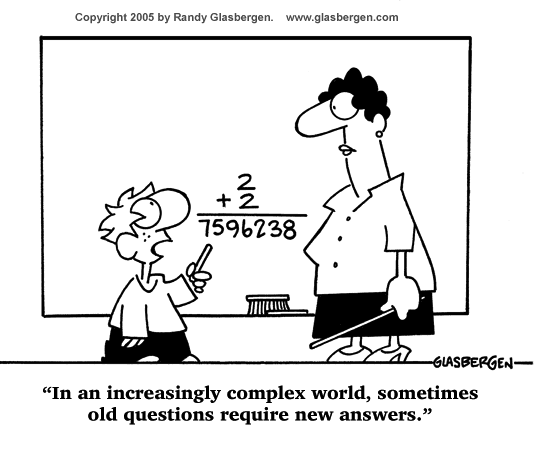
Someone in my PLN shared this cartoon on Facebook this afternoon. (I'm not posting a picture of it due to copyright).  That, in combination with a discussion stemming from a blog post entitled "What is UP with Multiplication Tables" by Lisa Cooley in the Innovative Educator Forum on Facebook recently, led me to this thought:

We ask students to add 2+2 and expect them to answer that it equals 4.

They'd be better off if we asked them to find examples of when it doesn't.  

Friday, December 7, 2012

Don't Be Standard

Do you want to drive a car that meets only the government's fuel efficiency standards, or do you want a car that exceeds them?

Do you want to live near a nuclear power plant that focuses only on the recommended standards for safety, or do you prefer that plant looks for additional ways to be safe?

Do you want to buy chicken at the supermarket from a company that uses just few enough hormones and chemicals to meet the FDA's standards, or chicken from a company that strives to make their food healthier?

Do you want to be the teacher who teaches students only the standards developed and handed to you by politicians, or do you want to be the teacher who inspires your students to learn more than just that?

Don't be standard. 

Wednesday, December 5, 2012

More is Not Better

In the last week there has been a lot of coverage of the upcoming addition of 300 hours to the school calendar in 5 states.  New York, Colorado, Connecticut, Tennessee, and Massachusetts will be requiring students to spend more time in school in order to "boost student achievement." 

When I first heard this, I had a flashback to a dinner party at a friend's house a few years ago.  I'm not going to mention this friend by name so as not to cause embarrassment, but she is a terrible cook.  Everybody enjoyed the time with friends, but nobody enjoyed the dinner.  The instant mashed potatoes were runny enough to be a soup, the meat was drier and tougher than a leather jacket, and I learned that peanut butter and lime are flavors that do not mix well in a dessert.  My wife and I politely ate enough as to not be rude while we were there, but quickly pulled some leftover pizza out of the fridge as soon as we got home.

Image:  freedigitalphotos.net
The problem with the dinner party was not that we needed more food.  The problem was that the food needed to be better.

That's how it is with our schools right now.  As long as we are providing education that focuses on test-prep, teacher directed lecture, irrelevant canned textbook lessons, and treating students as data that can be manipulated; more of it is not going to fix any of our problems.  In fact, it will probably make them worse. 

Just like forcing me to eat more of that brisket would have had awful consequences, forcing students who (correctly in most cases) have learned that school is irrelevant to endure more of it will not make the problem better.

As has been pointed out by many others covering this story before, American children already spend more time in school than their peers in Finland, Japan, South Korea, and other countries that we perceive as being "high-performing."  More time in school has not made us better in the past.  It won't make us better in the future.

What will make us better is to change our approach to education.  Make it student-centered.  Make it relevant.  Make it about learning and not about test-taking.  Because, if we do it right and teach our children to love to learn, they'll do it all the time.

They won't need to be in school all those extra hours in order to learn.  They'll be doing it everywhere they go and in everything they do.

And when that happens, other countries will be trying to figure out how they can design their education systems to be more like ours. 

Tuesday, November 13, 2012

Student Created Awesomeness

It's been too long since I last blogged.  I've got lots of excuses.  I've been busy training for my first half-marathon in Philadelphia this weekend.  I've been busy running an after-school club where students are free to explore and experiment with web2.0 technologies.  I've been busy developing a 3 credit course that begins in January entitled "Collaborating and Innovating in the Early 21st Century".  I've been busy helping my students be awesome. 

It's that last one that lit a fire under me and forced me to put this post up today.  Because my students have been pretty awesome lately.  And it would be a shame to not share their awesomeness.  So, here are a few of the many things they've been up to lately.

For the presidential election, my fifth graders in collaboration with our other two fifth grade classes participated in a nationwide student-run election.  Results were reported on a collaborative Google Doc and tabulated using electoral votes.  In all the years I've been teaching students about the Electoral College, never have they understood it more than this year when it was directly relevant to them. 

Students created voter registration cards, researched candidates' positions on the issues, ran the polling place, and calculated our schools' results to report.  I thouroughly enjoyed sitting back and watching them participate and learn.  Below are some pictures from the event.


Also, our fifth graders are running a food drive during the months of November and December to help the local food pantries.  In order to promote the food drive, my class organized an advertising campaign.  They split themselves into three groups and decided that one group would be in charge of producing a 30 second video ad, one group would transform a hallway bulletin board into a billboard, and one group would create posters to hang in the hallways.  I was blown away by their work.

Here's the video ad:


Here's the billboard:

The posters should be finished by the end of today, but they aren't ready for me to share yet. 

I'm really proud of the work my students are doing.  I'm proud because it's good work, but also because they are making a difference in the community and learning how rewarding that can be.  And they have ownership because it's their work.  They wrote, produced, and starred in the video (I was the camera person because their designated camera person was absent).  They designed and created the bulletin board with very little help from me (I helped them hang the background paper).

This is what learning should look like.  Students in charge.  Real problems being solved.  Teachers supporting and not leading.  Evaluation based on "How much of a difference did we make?" rather than "What was my test score?"

When students are being awesome, I am reminded why I love my job.

Friday, October 26, 2012

The Fight Against Common Core Irrelevance

We've been told again and again that the Common Core Standards are being put into place to prepare our students to be ready for college & career when they graduate high school.  These standards are supposed to better prepare students for life.

So why are schools buying textbooks to implement them?  If these standards are supposed to prepare our kids for life, wouldn't it make sense that the best way to teach them would be through life simulations?

Shouldn't every one of these standards have a real-world application?  And if so, why aren't we giving students the opportunity to use them in real-world settings?

The more we make a separation between the "real world" and the "fake world" of school, the more students will realize that we are irrelevant.  And they'll be right.

Friday, October 5, 2012

Happy World Teacher Day!

Today is World Teacher Day.  I placed this Thank You Card on the Faculty Room table in my school to tell the teachers I work with how appreciative I am for all that they do for both me and my children.

I also appreciate all of you in my PLNs:  in the blogosphere, on Facebook, on Twitter, on Plurk, and everywhere else that you all share and collaborate.  You help me become a better teacher.

Thank You!

Wednesday, October 3, 2012

Want Great Schools? Start Simple.

No teacher ever became great by being the best at following the textbook, being the best at reading from a script, or being the best at passing out multiple choice tests from the back of an assessment guide.

No school ever became great by having the best textbook programs from which their teachers read, the best benchmark tests, or the best canned lesson scripts for their teachers.

No country ever became great by having schools that were the best at selecting textbook programs for their teachers to use and the best test-prep programs.

A great national education system starts by having excellent public schools.  Public schools are excellent when they have excellent teachers facilitating learning.  Teachers can only be excellent when they have the autonomy to be.

If we want excellence, we need to start by thinking more simply. We need to start by allowing teachers to be great.  Then encourage them to share what they are doing to inspire others.

Because the current direction of demoralizing them and having them compete against each other simply isn't going to get us there.