Wednesday, February 6, 2013

Self-Reflection: Has My Teaching Been Effective?

I believe strongly that people need meaningful feedback to learn.  I try to provide opportunities for my students to get that feedback as often as possible and in a variety of ways.

In order for me to learn and grow as a teacher, I need meaningful feedback as well.  This is often difficult to get.  Test scores aren't the best measure of what's important in school, so it would be silly for me to use them as a self-reflection tool.

With that in mind, I asked my students to spend a few minutes filling out a five question survey yesterday.  Since I stressed to my students that the survey was totally anonymous and that I wanted them to be brutally honest, I was a bit anxious to see the results. 

Here's what I found:

Question #1 - Do you agree with the following statement?
I enjoy learning more than I did before this school year started.

Question #2 - Do you agree with the following statement?
I've learned a lot so far this year.
 
 
Question #3 - What are some things we have done so far this year that have made it easier for you to learn? (I paraphrased student responses and put them into Wordle - more frequent responses appear larger.)


Question #4 - What are some things Mr. Soskil can do better during the second half of the year to make it easier for you to learn?


Question #5 - What are some things that you (student) can do better during the second half of the year to make it easier for you to learn?


My reactions:
  • I'm disappointed by the number of students who are not enjoying learning more than in the past.  Increasing love of learning is one of my top goals.  I need to focus on this more.
  • I'm happy that my students feel that they are learning a lot.  I agree with them.  I've seen amazing growth in all of them.  I purposefully didn't include any clarification on what has been learned.  As long as they are learning, I'm happy.
  • This is my first year having my students blog.  I'm sold.  It was the number one response when listing the things we've done that have made it easier to learn.  I see that they are motivated to learn new things so that they have material to blog about, and I see that they are becoming better writers as they continue sharing that learning. 
  • The words "explaining" and "explanation" came up a lot in many of my students' responses.  I see that as a possible red flag that they still view me as the person who gives them information.  They learned more because I explained things more to them and want even more explanation of things going forward.  I worry that I'm not passing the control of their learning over to them as much as I had hoped I would.
  • On the other hand, many of them see that they need to seek information on their own in order to be more successful during the second half of the year.  That's encouraging. 
  • Many students' self-reflection responses ("pay attention more", "stop talking") tell me that I still have work to do in convinving them that learning isn't about sitting in one's seat and listening to the teacher.  I know that this group has difficulty listening to anyone who is talking, even when collaborating with others for a common purpose.  I'm hoping their responses are more about the issues when collaborating, but I doubt it. 

Tuesday, February 5, 2013

This I Believe

Yesterday Chris Lehmann posted a list of his 10 core beliefs as an educator on his blog, Practical Theory.  He asked his readers to post their core beliefs.  After some self-reflection, here are mine. 

What are yours?

This I Believe
1.  The most important things we do as teachers:  the moments that our students will carry with them for the rest of their lives, the truly meaningful actions that define who we are as teachers – cannot be measured.  If you think they can then you don’t understand what we do.

2.  Learning to love learning is more important that any information with which we can try and fill a child’s head.

3.  Children are born learners.  They are naturally curious and creative.  Teachers should do everything in their power to avoid participating in practices that stifle that curiosity and creativity.

4.  Measuring learning is significantly less important than actually learning.  It should be done only when doing so when the measurement is helpful to the learner.

5.  Grades do not help students learn.  They help adults rank, sort, and judge students.  Students need meaningful feedback from others to learn.  Numbers and letters placed on top of a test are not meaningful feedback. 

6.  The decisions we make in schools should be based upon what is best for the children we serve and not upon what is popular with parents, politicians, colleges, and corporations.

7.  Teachers need to get better.  Every teacher should be pursuing the goal of improving as a professional.  Teachers should be models of life-long learning.  If we focused our energy on providing the support, resources, and inspiration for EVERY teacher to constantly improve instead of identifying and firing those teachers who are “bad” using sketchy test data, every student would benefit immensely. 

8.  Math is not a series of procedures to be followed in order to arrive at correct answers.  Some think they are not good at math because they couldn’t memorize procedure.  Others think they are great mathematicians because they could.  In reality, there are many great mathematicians for whom calculation is not a great strength.  And there are many great calculators who are not good mathematicians.  We need to change how we present mathematics to our students so that “school math” and “real math” are one and the same.

9.  We live in a time of ubiquitous technology.  Student learning should happen in an environment that reflects that fact, but technology is just the tool of our time.  Good teaching is not determined by the technology used but by the quality of the pedagogy.  The basis of good teaching has been the same for millennia, but it may look very different in the 21st Century than it did when Socrates was teaching Plato.  Just as the Socratic Method was grounded in inquiry, our pedagogy should be student centered and driven by inquiry.

10.  Decisions should be based on data, research, and experience.  Too often decisions are based on data that is most convenient to obtain, cheapest to gather, or cherry-picked to prove a political point.  This does a terrible disservice to our children.  Using data incorrectly is more harmful than not using it at all, and some things cannot be quantified.  Just because we cannot measure what is truly important (see #1) does not mean that we should put importance on what we can measure.   
 

Sunday, February 3, 2013

Twitter May Not Be for All Teachers, But PLN is Vital

This morning, Royan Lee asked in a blog post, "Is Tweeting for Everyone?"  Having taught several PD sessions during the past few weeks on using Twitter to build a Professional Learning Network, I found this question to be interesting.  Here's my response (left as a comment on the post):
I don’t think that one needs to have a presence on Twitter to be an effective educator. But communicating with technology is a vital skill that we need to model for our students. If we are not collaborating and communicating with 21st Century tools, is it reasonable for us to think we are preparing our students for their futures? Twitter is simply one of many tools that can be used to tap into the collective wisdom of millions of educators around the world. The blogosphere is another avenue. Some like Plurk, others have found their PLN in more specialized places for music teachers, librarians, etc. There’s no right or wrong way to network. The days of being able to teach effectively by closing your classroom door and doing what’s always been done are over. The world is changing more quickly than it ever has before, information is exploding at exponential rates, and that information is more accessible than ever before. Good teaching looks different than it did 50 years ago, or even 5 years ago. It will look different 5 years down the road. Good teachers need a way to keep up with that. 


Friday, January 18, 2013

Allow Teachers the Chance to Be Excellent

Everybody wants excellent teachers.  Parents want their kids to have the best teachers, politicians claim to want teachers to be excellent, communities want their schools to have excellent teachers, and teachers themselves want to be excellent at what they do.  Regardless of how we feel about how to reach this goal, the desire for excellent teachers seems to be a universal desire.

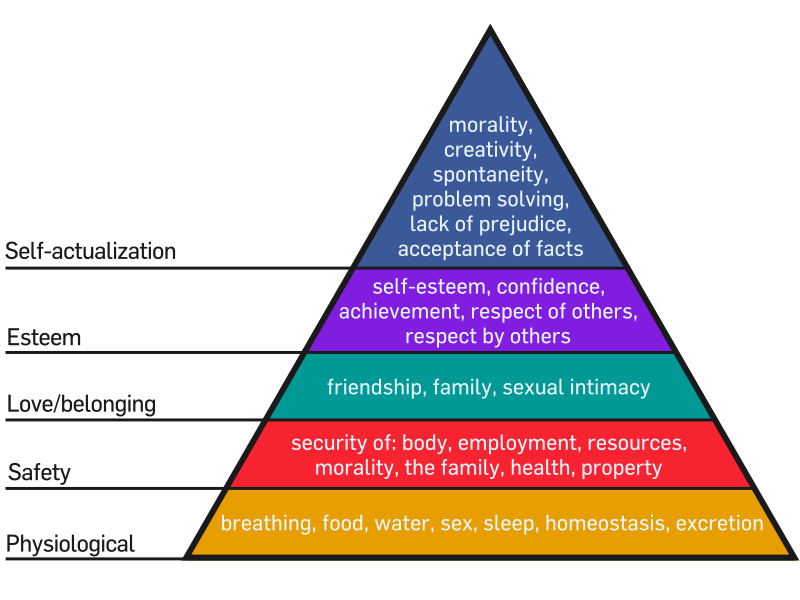
Every teacher certification program spends time teaching us Maslow's Hierarchy of Needs.  (I used the term 'teacher certification program' and not 'teacher preparation program' because I'm not familiar with what gets cut when 4 year college programs get squeezed into crash-course 5-week teacher prep programs like those offered by Teach For America.)  It's widely accepted that people cannot reach the higher levels of the Hierarchy without having their needs met at the lower levels.  We're taught this so that we can help our students learn.  Students who are hungry, sleep-deprived, unhealthy, etc. cannot learn until those needs are met.


Yesterday I was reminded of Maslow and his Hierarchy of Needs by this Tweet from R. Turner:

Teacher basic needs

The answer is obvious. Teachers, just like any other people, cannot be effective at anything without having their basic needs met.  I got thinking about Maslow, his Hierarchy and how it relates to teachers in today's education culture.

When we look at the Hierarchy, the qualities we find in excellent teachers like creativity, problem-solving, and lack of prejudice (objectivity) are all found at the top.  In order to reach that top teachers must have the needs below them met.


As we look at the needs below the top, we start to see some of the things that the reform movement of the last decade has targeted: teacher job security, respect of the teaching profession, resources available to teachers in schools.  It's clear that teachers are incapable of reaching their full potential without these necessities. 

The question we've got to ask then is, "What is the purpose of this reform movement?"  Either those pushing for these reforms believe that excellent teaching does not include objectivity, problem-solving, and creativity, or there is a motive other than excellent teaching behind their policies. 

Either way, we need to look in a different direction if we are to provide our students with the excellent education they deserve. 

Monday, January 14, 2013

First Grade #anyqs Cookie Eating Contest

This morning I got asked by one of the first grade teachers in my building if I would be willing to come into her classroom and teach a math lesson.  After hearing me talk about the need to step away from our textbooks, have more math discussion, and encourage students to develop the questions, she wanted to see what that would look like in first grade.  Of course, I happily accepted.

Immediately I started brainstorming how I could put together an #anyqs type video that was simple enough to bring about first grade discussion on addition and subtraction.  It's not often that I get the chance to work with our younger elementary students in the classroom.  The last time was over 10 years ago.  I don't remember much about that lesson on measurement other than making one student cry when I told him to stop sticking his measuring tape up his nose.

I enlisted the help of my wife, son, and daughter.  My wife held the video camera and let us borrow two plates of cookies that she baked for her high-school science classes. (We did eat a few of them before giving them back, but it was for a good cause.)  My kids played starring roles.

Here's what I came up with:


I'll pause it a few times during the lesson to see if we can get some good mathematical discussion going.

Let me know what you think.  Any changes you'd suggest?  I've done a ton of this type of lesson w/ my fifth graders before, but this is my first shot at doing it in the primary grades.

Sunday, January 6, 2013

I'm Not an EdTech Guy

I'm often referred to as a "tech guy" or an "ed-tech guy" in my building.  I use a lot of technology in my class.  My 5h grade students maintain a class wiki, blog regularly, use web 2.0 tools on a daily basis, create podcasts and videos, network with each other on Edmodo, and spend plenty of class time working on-line.
Image:  twobee/www.freedigitalphotos.net

But I am not an ed-tech guy.

I don't spend much time planning on how to integrate technology into my classroom any more.  There was a time when I did.  I was an ed-tech guy then.  I'd take my kids to the computer lab and teach them how to use web 2.0 tools for the sake of using 21st century technology.

Now, I just share the tools that are needed for my students to learn and share their learning with others.  The technology isn't the focus any more.  It's just the way things are done in the 21st century.  We don't spend time planning how electricity can be incorporated into our lessons.  It's just there if we need it.  Technology needs to be the same way.

Last week one of my students came to me and proudly showed off two new origami animals he invented.  I was really impressed and told him that he should draw step-by-step directions to share.  I told him he could probably sell such a book if he created a few more animals.  His creations were really good.  He told me that he would rather make a video because he'd be much better at explaining things verbally.

That's when I showed him how to use the digital camera we have to shoot video, upload to MyBrainShark, and embed the video in his blog.

During the same day, I had a few students who were researching important events in the history of manned flight.  They were drawing a timeline by hand in one of the student's notebooks with the events on it.  They asked me to borrow one of our digital cameras in order to take a picture of it to post on the wiki when they finished.  That's when I took them over to a free computer and introduced them to TimeToast and XTimeline.

When we get right down to it, learning hasn't changed in the 21st Century.  Collaboration, investigation, trial and error, getting feedback from others, and all of the other great ways that we learn are still great ways to learn- just like they were when Plato was learning from Socrates.

How we are able to do those things has changed, and that's where we need to adapt as teachers in order to prepare our students for the world in which they are going to be living.  But our attention still needs to be on the learning and not on the technology.

So, please stop calling me an ed-tech guy.  That's not my focus.

I'm a learning guy who helps my students navigate the world in which they are living.

Sunday, December 30, 2012

Math Education: We Need New Answers

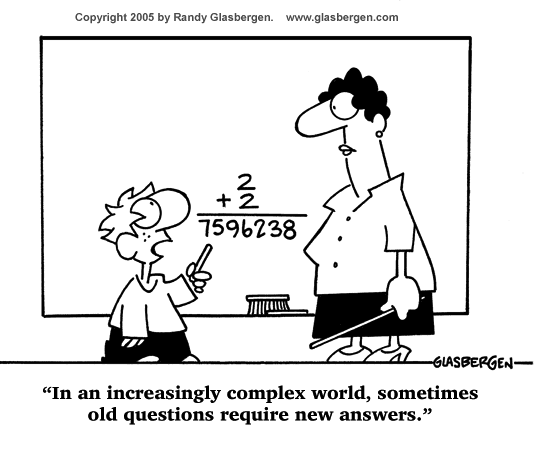
Someone in my PLN shared this cartoon on Facebook this afternoon. (I'm not posting a picture of it due to copyright).  That, in combination with a discussion stemming from a blog post entitled "What is UP with Multiplication Tables" by Lisa Cooley in the Innovative Educator Forum on Facebook recently, led me to this thought:

We ask students to add 2+2 and expect them to answer that it equals 4.

They'd be better off if we asked them to find examples of when it doesn't.